Running a GP practice means balancing two very different responsibilities: providing quality patient care and keeping the business operating efficiently.
Behind every consultation is a considerable amount of administration. Calls need answering, appointments need managing, referrals need following up, records need updating, invoices need processing and patients need communicating with.
As demand increases, this administrative workload can put pressure on receptionists, practice managers and clinicians alike.
The solution isn't necessarily to employ another full-time member of staff.
For many practices, the better question is:
Which administrative tasks could be handled remotely?
A medical virtual assistant can provide additional capacity without requiring another desk, another office or necessarily another full-time employee.
For New Zealand GP practices, this can mean additional support with reception, administration, patient communication, bookkeeping and practice management.
 The administrative challenge facing GP practices
The reception desk is often where many of a practice's competing demands converge.
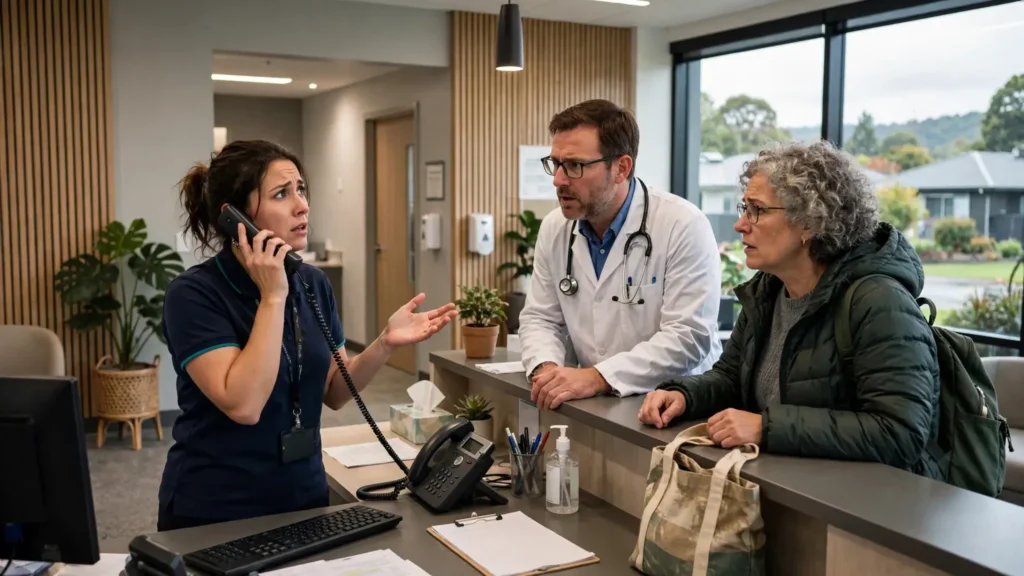
A receptionist may be answering the telephone while checking in a patient, responding to an email, processing paperwork and dealing with an appointment request.
At the same time, the practice manager may be dealing with staffing, suppliers, accounts, reporting and operational issues.
And doctors may find themselves completing administrative work outside their consulting hours.
None of these tasks are necessarily difficult individually. The problem is the volume and constant interruption.
New Zealand's focus on improving access to primary care makes efficient administration increasingly important. From 1 July 2026, the national primary-care health target aims for more than 80% of people to be able to access a general-practice appointment within one week.
Administrative support cannot solve every challenge involved in improving access, but reducing avoidable administrative pressure can give practice teams more capacity to concentrate on patients and higher-priority work.
The most useful way to look at virtual assistance isn't by job title.
Instead, look at the tasks consuming your team's time.
If your reception team spends much of the day answering calls, there may be an opportunity to move some of that workload away from the front desk.
A virtual medical receptionist can provide remote support for appropriate administrative calls and enquiries.
Depending on your agreed procedures, this could include:
A medical answering service can be particularly useful when your reception team is busy, dealing with patients face-to-face or temporarily unavailable.
This doesn't necessarily mean replacing your existing receptionist.
Instead, it can provide an additional layer of support during periods when demand exceeds the capacity of your in-house team.
For some practices, outsourcing selected reception functions makes more sense than recruiting another permanent employee.
Your existing receptionist can remain focused on patients physically at the practice while a remote team handles suitable telephone and administrative tasks.
This hybrid approach can be particularly useful for smaller practices where the workload doesn't justify another full-time position.
Reception is only one part of the administrative workload.
Many practices also spend substantial amounts of time on routine tasks that don't require someone to be physically present at the practice.
This can include:
A GP administrator or medical office assistant working remotely can take responsibility for some of these tasks, helping prevent routine administration from accumulating.
The advantage is flexibility.
A practice might need several hours of administrative support every week, rather than another full-time employee sitting at a desk every day.
The administrative workload becomes broader as a practice grows.
Practice managers may find themselves spending time coordinating staff, managing suppliers, organising documents, preparing reports and following up on tasks that could potentially be delegated.
A remote GP practice manager support service can provide additional administrative and operational capacity without requiring every task to be handled on-site.
Depending on the practice, support could include:
This isn't about replacing the practice manager.
It is about giving the practice manager another pair of hands.
That distinction is important.
The more routine work that can be delegated, the more time a practice manager has for staff, patients, operational improvements and the wider running of the practice.
Financial administration is another area where routine work can consume valuable time.
A practice will still need appropriate professional accounting and tax advice. A qualified medical practice accountant remains responsible for services requiring professional accounting expertise.
However, many of the administrative tasks supporting the financial process can potentially be outsourced.
GP bookkeeping and financial administration support might include:
The objective isn't to replace your accountant.
It is to make sure the routine administrative work supporting your financial processes is kept organised and up to date.
Not everything should be outsourced.
Clinical decisions, clinical judgement, patient care and tasks requiring physical presence should remain with the appropriately qualified members of your practice team.
The better question is whether a particular task needs to be performed by someone inside the practice.
A simple way to assess your workload is:
| Keep in-house | Consider outsourcing |
|---|---|
| Clinical decision-making | Data entry |
| Clinical assessment | Telephone overflow |
| Face-to-face patient care | Appointment administration |
| Tasks requiring physical presence | Routine correspondence |
| Clinical triage | Document preparation |
| Patient care decisions | Follow-up administration |
| Practice-specific clinical responsibilities | Bookkeeping administration |
There will obviously be exceptions depending on your practice, systems and procedures.
The point is to identify the work that requires professional judgement or physical presence and separate it from the routine administration surrounding it.
One of the biggest misconceptions about outsourcing is that it means replacing existing employees.
It doesn't have to.
For a GP practice, the most useful model may simply be additional administrative capacity.
Imagine your receptionist is dealing with three patients at the front desk while the telephone is ringing.
Instead of expecting the receptionist to manage everything simultaneously, a virtual medical receptionist can deal with appropriate incoming calls.
Or perhaps your practice manager has several hours of paperwork and administrative follow-ups every week.
A remote administrator could take those tasks off their list.
The result isn't necessarily fewer employees.
It can simply mean that your existing employees spend more of their time doing the work that requires them to be there.
There are several signs that your practice could benefit from additional virtual support.
If receptionists rarely have time to complete their administrative work because they are continuously dealing with patients and telephone calls, additional support could help.
If incoming calls frequently go unanswered during busy periods, a medical answering service or virtual receptionist could provide additional capacity.
If operational and administrative tasks are regularly being pushed to evenings or weekends, some of that workload may be suitable for remote assistance.
If clinicians are spending significant time on routine administration that could be delegated, it is worth reviewing which tasks actually require their involvement.
Holiday and sickness cover can be difficult for smaller practices. Flexible virtual assistance can provide additional capacity without requiring a permanent recruitment decision.
This is perhaps the simplest reason of all.
You may have enough work to justify additional support but not enough to justify another full-time position.
A flexible virtual assistant allows you to scale support around your actual workload.
Healthcare administration requires a different level of care from ordinary business administration.
Before working with a provider, consider:
Healthcare experience
Does the provider understand the administrative environment of medical practices?
Confidentiality and security
How is patient information handled? What access controls and security procedures are in place?
Clear responsibilities
Can the provider work according to your practice's procedures and clearly understand what should be escalated?
Flexibility
Can you use support for a defined number of hours or tasks rather than committing to a full-time employee?
Communication
Will you have a clear point of contact and a reliable process for communicating priorities?
Scalability
Can the level of support increase if your practice grows or your workload changes?
The right arrangement should fit around your practice rather than forcing your practice to adapt to a rigid outsourcing model.
GP practices have enough to manage without allowing routine administration to become another source of pressure.
A medical virtual assistant can provide flexible support across reception, GP admin, patient communication, bookkeeping and practice administration.
A virtual medical receptionist can help with telephone and reception overflow.
A GP administrator or medical office assistant can take care of routine administrative tasks.
A remote GP practice manager support service can provide additional operational capacity.
And GP bookkeeping support can help keep routine financial administration organised.
The key is not to outsource everything.
It is to identify the tasks that are consuming your team's time without requiring someone to physically sit inside your practice.
For many practices, that can provide a relatively simple way to increase administrative capacity while allowing existing staff and clinicians to concentrate on patients and the work that matters most.
Reliable Solutions provides flexible virtual administrative support for healthcare providers across New Zealand, including appointment administration, patient communication, telephone answering, billing administration, data entry and virtual receptionist services. Learn more about Reliable Solutions' virtual assistant services for healthcare
If your practice is spending too much time dealing with routine administration, Reliable Solutions can help you identify which tasks could be handled remotely and develop a support arrangement around your requirements.
Get in touch with Reliable Solutions to discuss how virtual administrative support could work for your GP practice.